The Hidden Door: A Journey Through Dreams and Art
Updated: Jul 6
It all began with a dream. In that dream, I found myself repeatedly saying the words: "Ash Leigh" or "Ashley Dance." Only later did I discover that in Old Irish, Aisling (pronounced ash-ling) means "dream" or "vision" (Robert Moss). The dream lingered it had a peculiar feeling and charged with energy.
I followed the thread of that dream, which led me to a crown chakra activation event in Stirling with Matias De Stefano and R. E. Grant. During the activation, I climbed to the top of the Wallace Monument. Standing there among the eight arches that crown the tower, I offered a prayer for a friend navigating a difficult period in their life.
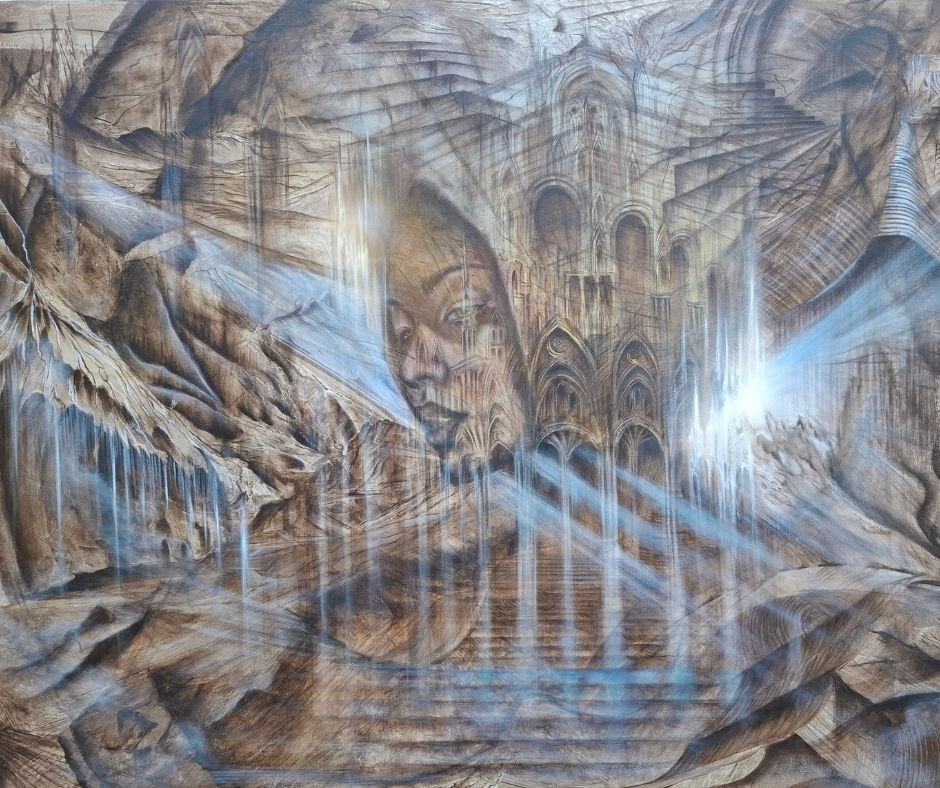
As I looked around, I was suddenly reminded of one of my paintings, The 8th Dimension. It really felt like synchronicity in action, events unfolding mysteriously.
The Dance of the hidden door
A few weeks later, another dream door appeared. This time, it was the Hidden Door Festival, held within the urban ruins of an old paper factory in Edinburgh. I had been whirling for three weeks, almost every day, just repeating the word "Ash." It felt like my body wanted to spin at any moment, so I let myself move into that circular motion, sometimes 5, 6 times a day.
ASH, the Art of Spontaneous Humanity. At first, the experiment appeared to be an exploration in movement or participatory art. Yet the more we explored it, the more it seemed to explore something deeper: agency, relationship, and the living nature of creativity itself.
My inquiry revolves around questions that often remain hidden beneath the surface of the everyday mind, festivals and cultural events. Festivals frequently operate through an unconscious division of roles. Artists create, and audiences consume. But what happens if that boundary begins to soften? What happens when audiences become co-creators? When witnessing becomes participation? When a forgotten corner of a festival transforms into a living ecosystem where art continuously appears and disappears?
The Space Between
During conversations with Roddy, Rosie, Chloe, Markulf, and Amy, we found ourselves returning to the festival's own name: Hidden Door. We also reflected on the concept of Ma 間 in Japanese, which means "the space in between." Having studied Japanese and Chinese characters back in France when I was a student, I looked at the composition of this character 間, which is made of the character for door and the sun in the middle.
Symbolically, our experiment seems to ask whether there is another hidden door concealed within the festival itself. A hidden door in the architecture of participation. A threshold between watching and presence.
The visible activity may simply be a small group of people moving through an abandoned factory space among the visual art installations. Yet beneath that surface lies a deeper inquiry, one that mirrors fundamental questions about human consciousness and relationships. What happens when the distinction between observer and creator begins to dissolve?
The Emergent Relational Field
Most social environments are structured through predefined roles: artist and audience, teacher and student, performer and witness. These distinctions can be useful and necessary, yet they also determine what kinds of relationships and experiences are possible. Our exploration seems to inhabit a third space: not a performance, not an audience either, or maybe both and none at the same time?
I think of it as an emergent relational field: a temporary zone where experience is co-created through presence, attention, movement, curiosity, responsiveness, and play. Within such a field, no one knows exactly what the artwork is because the artwork is continuously being generated by the relationships unfolding in real time.
From a consciousness perspective, the question becomes: What forms of awareness, connection, and creativity become possible when people are invited out of passive observation and into shared emergence? For me, this is as much a research question as an artistic one. It is something I explore daily through movement, dreamwork, creative practice, and the study of participation itself.
Dreams and Reality
Dreams rarely maintain rigid boundaries between self and world. The dreamer and the dreamed intermingle; characters emerge, transform, disappear, and reappear within an alive, always-changing landscape of meaning. Our experiment carries a similar quality. Visitors may arrive believing they are observers of an artwork, only to discover that their attention, hesitation, curiosity, movement, or participation is actively shaping the experience itself.
Perhaps this is the hidden door we are exploring—not really a physical entrance within an old factory, but a threshold in perception itself. A doorway into a different way of relating to art, to one another, and perhaps even to consciousness. A doorway that only appears when someone steps into it.
The Invitation to Explore
As I reflect on this journey, I invite you to consider your own relationship with art and dreams. What hidden doors might you discover in your life? How can you engage with the world around you in a way that transforms passive observation into active participation?
The journey is ongoing, and the exploration is as vital as the destination. Each moment holds the potential for discovery, connection, and creativity. I'm embracing the dance of spontaneity and the art of being present. Together, we can weave a tapestry of experiences that resonate deeply within our souls.
In this space, I find the essence of my work. I aim to share my unique visionary and dream-inspired art with a global audience, fostering a deeper connection to nature, dreams, imaginative power, and the subconscious. Through my diverse artistic expressions, I invite you to explore your own inner worlds.


Comments